Here is your guide on how to write cliffhangers your readers will absolutely hate to love. When you master this craft, you may be able to transform a casual reader into a fan.
But there is a fine line between a thrilling chapter ending and a cheap gimmick. If you want to keep your audience hooked without frustrating them, you need to understand the psychology behind narrative tension.
What Makes a Cliffhanger "Hated" vs. Loved?
It is 2:00 AM. Your eyes burn, your alarm goes off in five hours, and you promise yourself, just one more chapter. Then you hit the final sentence. Suddenly, your heart rate spikes, your eyes widen, and you reach to turn the page. You are trapped, and you know it.
Learning how to write cliffhangers that evoke this exact reaction is the ultimate goal for any fiction author.
To understand why human brains are powerless against a great ending, we have to look at psychological science. Evolutionary biology and cognitive biases force our minds to judge an entire journey based almost entirely on its final moments.
There is a concept known as the Zeigarnik effect. This theory states that the human brain remembers uncompleted or interrupted tasks much better than completed ones. When a story arc closes cleanly, the brain files it away and relaxes. When an arc is left dangling, the brain stays alert, demanding a resolution.
This is exactly how to write cliffhangers that work naturally. You are intentionally denying the reader's brain a sense of closure.
However, your readers will quickly grow to hate your book - in a bad way - if that lack of closure feels unearned. A "hated" cliffhanger relies on cheap tricks or narrative lies.
For example, ending a chapter with a character slipping off a cliff, only for the next chapter to reveal they just tripped on a carpet, feels manipulative.
A "loved" cliffhanger, on the other hand, is entirely fair. The danger or revelation is completely real. The reader is furious that they have to keep reading to find out what happens next, but they respect the story enough to turn the page.
The Ultimate Literary Example: Misery by Stephen King
If you want a masterclass in this balance, look no further than Stephen King’s psychological thriller, Misery. The protagonist, Paul Sheldon, is a novelist held captive by his "number one fan," Annie Wilkes. Throughout the novel, King uses micro-cliffhangers at the end of almost every chapter.
In one iconic sequence, Paul manages to sneak out of his room using a bobby pin to unlock his door. He explores the house, searching for a way out, only to hear Annie’s car pull back into the driveway. He scrambles back to his room, desperately trying to lock the door and arrange his wheelchair exactly as it was before she walks through the front entrance.
King cuts the chapter right as the front doorknob begins to turn.
Why does this work so brilliantly? Because the stakes are incredibly high and the threat is immediate. King doesn't trick the reader; he places a character we care about in a logical, terrifying situation and pauses the clock. It forces the reader into an emotional chokehold.
How to Write Cliffhangers: The 4 Strategic Steps
Now that you understand the psychology of tension, let's explore exactly how to write cliffhangers using four distinct mechanical approaches. Alternating between these styles keeps your pacing unpredictable and fresh.
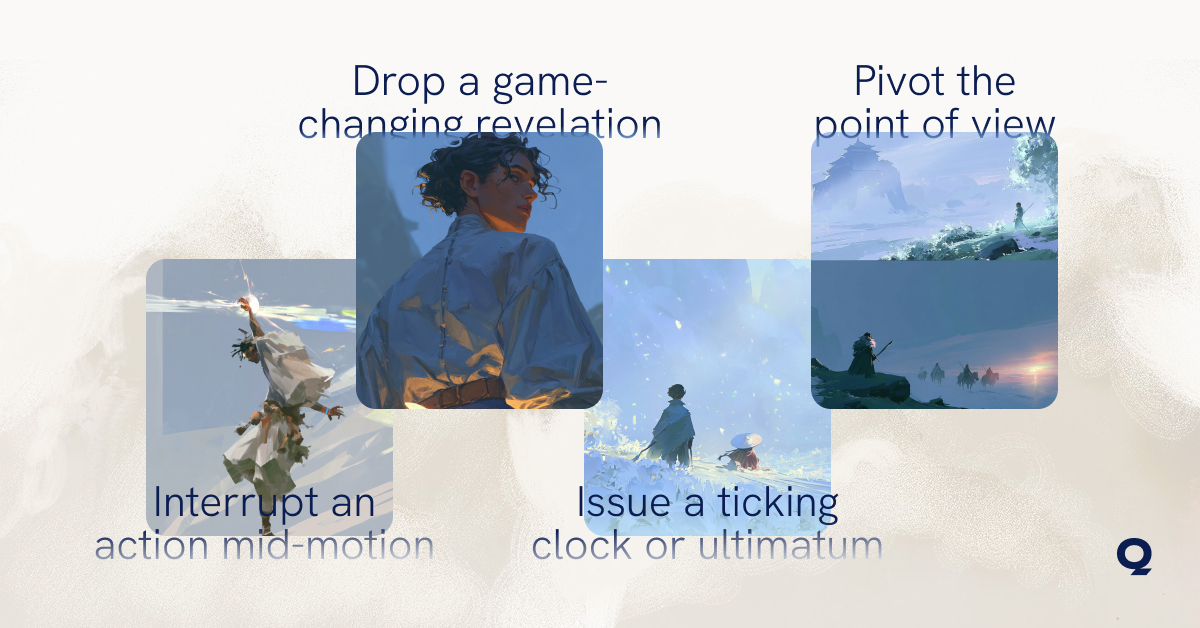
Interrupt an Action Mid-Motion
This is the classic physical cliffhanger. To execute this correctly, build a high-stakes scene toward a definitive climax, and then cut the narrative feed right at the moment of impact.
The framework: A character fires a gun, leaps across a widening chasm, or cuts the blue wire on a bomb timer.
Why it works: It forces an immediate question in the reader’s mind: Did they make it?
Drop a Game-Changing Revelation
You do not always need physical danger to create tension. An informational cliffhanger changes the context of everything that came before it.
The framework: A character opens a long-lost letter, looks at a DNA test result, or discovers a trusted mentor is actually working for the antagonist.
Why it works: It appeals to intellectual curiosity. The reader doesn't just want to know what happens next; they have to re-evaluate the entire plot.
Issue a Ticking Clock or Ultimatum
Time pressure forces characters to make desperate, rushed decisions. Ending a chapter with an impossible choice or a strict deadline creates immense psychological friction.
The framework: The villain delivers an ultimatum: "You have twenty minutes to choose which hostage lives." Or, an onboard computer announces an unalterable system countdown.
Why it works: It creates a sense of dread that makes it impossible for the reader to close the book and sleep soundly.
Pivot the Point of View
If you are writing a multi-POV novel, structural placement is everything. Master the art of the cutaway by pausing a storyline right at its peak and switching to a completely different character in the next chapter.
The framework: Character A discovers a hidden trapdoor. Instead of showing what is inside, Chapter 2 switches to Character B, who is miles away trying to send a warning message.
Why it works: It creates a craving for information that forces the reader to speed through the secondary storyline to get back to the primary mystery.
Common Mistakes to Avoid When Writing Cliffhangers
Even if you know how to write cliffhangers, it is easy to overplay your hand. To make sure you don’t frustrate your readers, avoid these three critical structural pitfalls.
Overusing Cliffhangers
If every single chapter ends with a life-or-death explosion, your readers will experience emotional burnout. Tension requires contrast. You must follow intense peaks with quieter, slower chapters to let the audience “breathe.”
False Alarms
Never use false alarms to manufacture drama. If your chapter ends with a scream, the next chapter cannot open with, "It was just a loud yawn." This breaks the unspoken narrative contract between the author and the reader.
Delaying the Payoff Too Long
If you pivot away from a massive cliffhanger, resolve it quickly. Leaving a major plot thread dangling for five chapters while focusing on minor subplots causes frustration, which breaks immersion and leads to abandoned books.
Writing an unputdownable book is not about using cheap shock value. It is about understanding human psychology, building authentic stakes, and knowing precisely when to pause the clock.
Looking for a writing community to help you improve your cliffhangers? See how to find the right writing Discord server for you, or simply join our Discord server!
Alternatively, dropping a cliffhanger question into our Subreddit will instantly spark a massive debate because every writer has a fierce opinion on how to execute them. Post your question and get a quick reality check!